Medieval Islamic Civilization

Course Discussion Website

Page 28 of 31

Bard Graduate Center Symposium—Antiquarianism in the Islamic World

“‘Antiquarianism’ is the term of art used to describe the investigation of the European past through its material remains before art history and archaeology emerged in the nineteenth century as the disciplines devoted to its study.”

This symposium is on the study of how the Islamic world studied the past.

Titles of ~30-45 minute talks include: -The Wisdom in Ruins: Veneration of the Material Past in the Medieval Islamic World —The Notion of Ruins in the Medieval Islamic World -Appreciating, Collecting, and the Meaning of Ancient Objects in the Early and Middle Islamic Period -Negotiating Cultural Continuity in Early Islam: The Future of Ancient Knowledge –The Near Past, the Distant Past, and the Political Legitimacy of the Fatimids and Buyids -Antiquarianism and Encyclopedism in the Fourteenth Century -Artefacts as Evidence in Muslim Historical-Legal Scholarship -Philology, Forgery, and Superstition: The Fierce Debate over the Shrine of Sayyida Zaynab in Early Twentieth-Century Egypt

(“Bard Graduate Center is devoted to the study of decorative arts, design history, and material culture through research, advanced degrees, exhibitions, publications, and events.”)
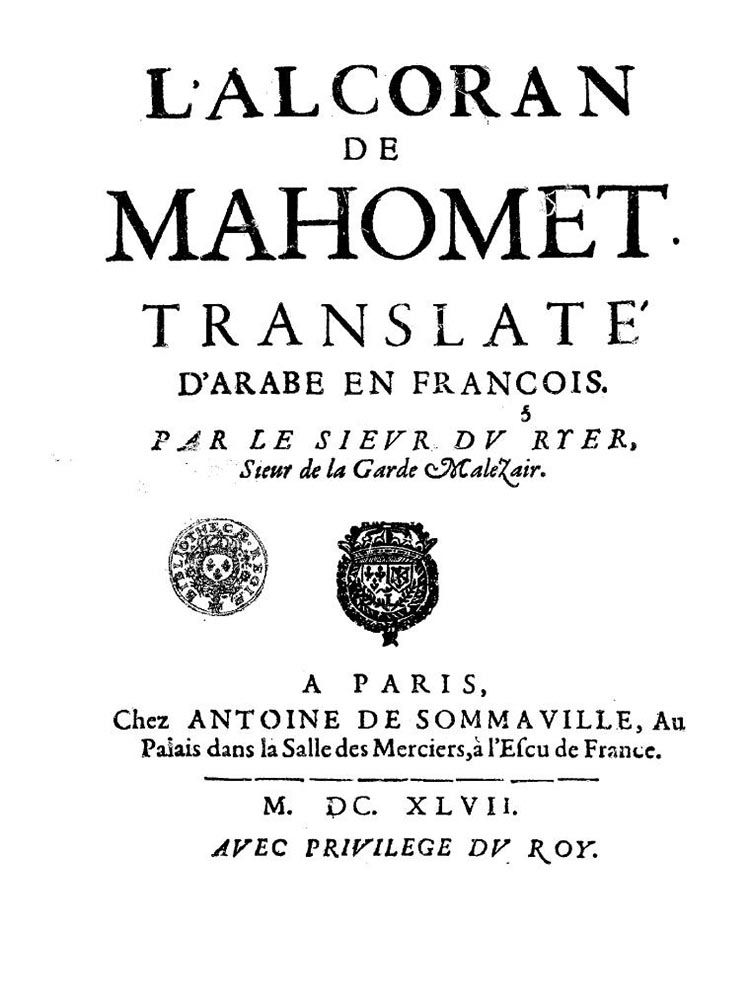
Muhammad, Republican Revolutionary?

“In 17th-century England, talking about Islam was a way of criticising the powers that be. When an introduction to the first translation of the Quran described a ‘leader of a band of fugitives’, was it aimed at the Prophet or Oliver Cromwell?”

L'Alcoran de Mahomet, André du Ryer, 1647.
The first English translation of the Koran was not from an Arabic text but a French translation of Arabic.

Link

The important take away from this is the denegrating tone toward Islam in the 17th century.

Rising seas threaten Egypt’s fabled port city of Alexandria

This article was published in Fredericksburg’s local newspaper, the Free Lance Star, a bit over a week ago. Poorer neighborhoods and archaeological sites in the over 2000-year-old Egyptian city of Alexandria are being threatened by floodwaters and rising sea levels.

https://www.fredericksburg.com/news/national/rising-seas-threaten-egypt-s-fabled-port-city-of-alexandria/article_d1b279c1-cd8b-57c8-83fd-0cbffcf2f108.html

Afghanistan is bracing for new wave of violence after U.S and Taliban talks halt.

This article from the Washington post goes in depth about how people in Afghanistan are expecting violence to break out. This is do to the falling out of talks between the Trump administration and the Taliban. https://www.washingtonpost.com/world/asia_pacific/afghans-brace-for-fresh-violence-after-us-taliban-talks-halt/2019/09/09/9e686c82-d2c4-11e9-8924-1db7dac797fb_story.html?noredirect=on

What the U.S. Invasion Affect the Black Market

If you ever wondered how the 2003 U.S. invasion of Iraq affected archaeology in the region, this Atlantic article talks about how easy ancient Mesopotamian artifacts have ended up online on the black market. For example, you can find a terracotta fragment bearing a god on a chariot for $225 on Live Auctioneers and even more shocking, they are being sold out of London.

Link: https://www.theatlantic.com/international/archive/2018/03/iraq-war-archeology-invasion/555200/

Did you know there is a Museum of the Palestinian People in DC?

Exterior of the Museum of the Palestinian People

There sure is–brand new and complete with seasonal exhibits and everything.

Here’s the info from their “visit us” page on their website:

Open Thursday – Saturday, 12pm-6pm.

General admission – $5/person. Purchase at the door. Donations are welcome.

*Tours for 5+ people can be arranged outside normal weekly hours when booked at least two weeks in advance by emailing info@mpp-dc.org.

Located at 1900 18th St. NW, Washington, DC 20009, on the corner of 18th and T street.

« Older posts Newer posts »