This is one video (of many) done by a doctoral student of Middle East studies. He explains asabiyya further, Ibn Khaldun’s visit with Timur, and why Ibn Khaldun is considered the father of sociology and other studies, like economics.
Page 19 of 31
My explanation of his elephant clock was rough (and wrong in one part), so here’s a better one with animation.
Here is an article with the best pictures of museum reproductions of a few of his works including the party boat.

If medieval automation interests you, I suggest E.R. Truitt’s Medieval Robots: Mechanism, Magic, Nature, and Art, published by the University of Pennsylvania Press. She cites her many sources well. While it is an academic read, it does not “read” like one.
This is available as an ebook through the library.


While the History channel on television is so “ugh,” their website still occasionally produces pretty good content. This quick, easy, and fun read is about a 14th century Moroccan who leaves home, after (literally) dreaming about distant lands, and pin-balls himself between Spain and China for roughly twenty years. His adventures are both harrowing and hilarious. Have a read. See for yourself.

Apparently the Ottomans loved their feathered friends. They built palaces for them on their own palaces (and mosques, and schools, and bridges, and . . . ). They’re all over Turkey, particularly in Istanbul.
Here’s a popular website article about them.
And here’s an article about them with ten sources and more pictures.
This video is pretty well put together and neatly summarizes the overarching history we’ll be going into deeper detail on this semester. It’s not quite a documentary but it does give a bit of levity to the history of the empire, which I find helps me to remember things.
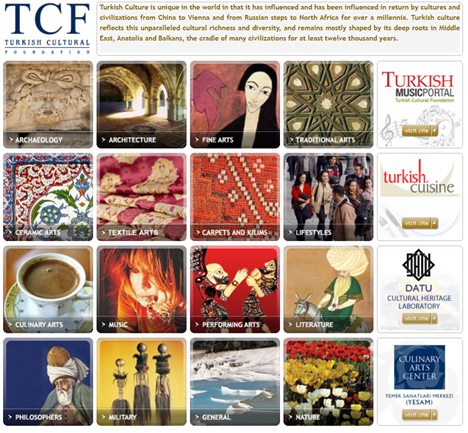
If I were to research material culture, I’d definitely spend some time at the Turkish Cultural Foundation’s website. While their library’s searchable online catalog shows you what is available in their library in Istanbul, it will at least provide names and titles you may be able to find elsewhere.

Because sometimes a super simple explanation makes the difference.
Two tabs are helpful: Religion in the Middle East and Ethnic Groups in the Middle East.

Peruse this site’s:
*reproductions of Ottoman silk brocades using the original 16th century method.
*results of dyestuff analyses on textiles from all over the Middle East
*list of museums who participated in the analyses
*lots of further resources for studying dyes of the Medieval and Modern Eras

The Institute for Palestine Studies-USA and the Middle East Institute are pleased to announce “Keyword: Palestine II,”* an exhibition of artworks donated by Arab and Palestinian artists to the Institute for Palestine Studies-USA. The exhibition will be open from March 2nd – 20th and will be accompanied by a silent auction of the artworks.
Proceeds from the sales will go to support the Institute for Palestine Studies-USA. The Institute’s work has been a model of independent thinking and sober scholarly work on Palestinian and Arab affairs through historical and academic research and documentation.
Bids can be placed at www.keywordpalestine.com following the opening.
These artists were brought together by a common aim – to support the Institute for Palestine Studies in order to assert the Arab character of this institute, highlight the centrality of the Palestinian cause and reinforce the ties of communication and cooperation between intellectuals, artists, and academics in the Arab world.
*The first edition of this exhibition took place in Beirut, Lebanon in 2018.
For more deets, see here.

The “Republic of Turkey Ministry of Culture and Tourism” has an article on the Turkish Cultural Foundation’s website that briefly explains the origin of dervishes before focusing on Haci Bektas-i Veli (“a great Turkish thinker”). The brief explanation of dervishes alone is worth the click.